Discover expert fitness tips, workout guides, nutrition advice, and wellness insights. Your go-to resource for fat loss, muscle building, and a healthier lifestyle.
Calculate the calories burned during your daily activities. Enter your weight, select your activity, and track your duration for accurate results.
Everyday Home Activities & Your Calorie Burn 🏃♀️
Hey there! Ever wondered how many calories you burn doing everyday tasks? As a fitness expert, I'm excited to show you how your daily routines contribute to your overall energy expenditure. Recent research (clinical studies) confirms that daily activities play a crucial role in maintaining a healthy lifestyle!
The Power of Daily Movement 💪
Great news! Your everyday activities are secret calorie burners. Scientific research (metabolic studies) shows that regular household tasks can significantly boost your daily energy expenditure. Even simple chores count towards your daily activity goals!
Science Behind Daily Burns 📊
Using advanced research methods (energy expenditure analysis), we can now accurately measure how many calories you burn during various household activities. Check out our comprehensive guide below!
Calories Burned by Household Chores
High-Energy Household Tasks (MET: 5.0-9.0)
Activity (MET)
30 min 68 kg
30 min 79 kg
30 min 91 kg
Moving Boxes Upstairs (9.0)
540 cal
630 cal
720 cal
Vigorous Floor Scrubbing (6.5)
390 cal
455 cal
520 cal
Moving Furniture (5.8)
348 cal
406 cal
464 cal
Playing with Children, Vigorous (5.8)
348 cal
406 cal
464 cal
Carrying Groceries Upstairs (5.3)
318 cal
371 cal
424 cal
Maple Syruping/Sugar Bushing (5.0)
300 cal
350 cal
400 cal
Moving, Lifting Light Loads (5.0)
300 cal
350 cal
400 cal
Moderate-Energy Tasks (MET: 3.0-4.9)
Activity (MET)
30 min 68 kg
30 min 79 kg
30 min 91 kg
Organizing a Room (4.8)
288 cal
336 cal
384 cal
Floor Polishing (4.5)
270 cal
315 cal
360 cal
Multiple Tasks, Vigorous (4.3)
258 cal
301 cal
344 cal
Laundry, Moderate Effort (4.0)
240 cal
280 cal
320 cal
Fast Sweeping (3.8)
228 cal
266 cal
304 cal
Packing/Unpacking Boxes (3.8)
228 cal
266 cal
304 cal
Mopping Floors (3.5)
210 cal
245 cal
280 cal
Childcare, Standing Activities (3.5)
210 cal
245 cal
280 cal
Carrying Groceries (3.5)
210 cal
245 cal
280 cal
General Cleaning (3.3)
198 cal
231 cal
264 cal
Window Cleaning (3.3)
198 cal
231 cal
264 cal
Vacuuming (3.0)
180 cal
210 cal
240 cal
Light Daily Activities (MET: 1.3-2.9)
Activity (MET)
30 min 68 kg
30 min 79 kg
30 min 91 kg
Multiple Tasks, Light (2.8)
168 cal
196 cal
224 cal
Sewing with Machine (2.8)
168 cal
196 cal
224 cal
Light Cleaning (2.5)
150 cal
175 cal
200 cal
Dusting Furniture (2.5)
150 cal
175 cal
200 cal
Building a Fire Inside (2.5)
150 cal
175 cal
200 cal
Cooking/Food Prep, Walking (2.3)
138 cal
161 cal
184 cal
Laundry, Light Effort (2.0)
120 cal
140 cal
160 cal
Washing Dishes (2.0)
120 cal
140 cal
160 cal
Ironing (1.8)
108 cal
126 cal
144 cal
Knitting, Sitting (1.3)
78 cal
91 cal
104 cal
Handwashing (1.3)
78 cal
91 cal
104 cal
Pro Tips for Maximizing Daily Calorie Burn:
🔥
Add Intensity
Speed up your movements during chores - the faster you move, the more calories you burn!
⏱️
Time It Right
Break tasks into 30-minute sessions throughout the day for consistent energy burn.
💪
Multi-Task Smart
Combine activities when possible - like squats while loading laundry!
📈
Track Progress
Keep a log of your daily activities. For more tracking options, check out our exercise tracking tools.
The Science of Calories Burned During Everyday Household Activities
These calculations are based on scientific data from the Compendium of Physical Activities. Remember, actual calorie burn varies based on factors like intensity, body composition, and fitness level (research insights).
FAQs
Get expert answers about calories burned during everyday activities! Our science-backed insights help you understand how your daily routines contribute to your overall fitness journey.
Q
How are daily activity calories calculated? 📊
A
We use the scientifically validated formula: Calories = T × 60 × MET × 3.5 × W ÷ 200. Here, T is activity duration in hours, MET is the activity's intensity (ranging from 1.3 for light tasks to 9.0 for vigorous activities), and W is your body weight in kilograms. This formula is backed by research from the Compendium of Physical Activities.
Q
Which household tasks burn the most calories? 🔥
A
According to research (energy expenditure studies), moving boxes upstairs (9.0 METs), vigorous floor scrubbing (6.5 METs), and moving furniture (5.8 METs) are top calorie-burning activities. These tasks combine strength, cardio, and full-body movements.
Q
How does activity intensity affect calorie burn? ⚡
A
Activity intensity directly impacts calorie burn. Light activities (1.3-2.9 METs) like ironing burn fewer calories than moderate tasks (3.0-4.9 METs) such as general cleaning. High-intensity activities (5.0+ METs) like moving furniture maximize energy expenditure (research data).
Q
Can daily chores replace a workout? 💪
A
Yes, when done with sufficient intensity! Research (activity analysis) shows that 30 minutes of vigorous household tasks can provide similar benefits to a moderate workout. The key is maintaining consistent movement and proper form.
Q
What factors affect calories burned during chores? ⚖️
A
Several factors influence energy expenditure: activity type, intensity level, duration, body weight, fitness level, and movement efficiency. Studies (research findings) show that personal factors can cause variations in calorie burn rates.
Q
How can I boost calorie burn during daily tasks? 🎯
A
Maximize your energy expenditure by: 1) Increasing movement speed and intensity, 2) Combining tasks for continuous activity, 3) Adding extra movements (like squats while loading laundry), 4) Taking stairs whenever possible, and 5) Maintaining proper posture. For more workout options, check our exercise guides.
This blog will examine each exercise’s biomechanics, benefits, and unique challenges. By the end, you will understand which help is helpful and how to incorporate it into your routine for optimal gains.
Spider curls are a bicep isolation exercise performed on an incline bench. The easiest way to do them is with dumbbells, and you can also use other equipment such as an EZ-Bar or barbells.
The exercise’s design focuses attention on the negative portion of each rep (when you lower the weight back to the starting position). This promotes a strong brain-muscle connection and maximizes time under tension — both are essential aspects of muscle growth.
Additionally, it’s virtually impossible to cheat with the bench curl. Since this movement completely isolates the biceps, you cannot use momentum to make reps easier, as people often do when doing seated or standing bicep curls.
Incline curls differ from traditional curls due to the incline bench and position of your elbows, which are behind your body and extend your shoulder joint. This unique setup provides several benefits that many other bicep curl variations don’t offer.
Adding incline curls to your workout routine gives you more variety, refreshes, and prevents plateauing.
The incline dumbbell curl allows your bicep muscle fibers to experience a deep stretch at the bottom of each repetition.
This increased stretch leads to a greater range of motion.
The chest-supported T-bar row is popular among fitness enthusiasts for building a strong, well-defined back. However, not everyone has access to a T-bar row machine or finds the exercise comfortable or suitable for their fitness level.
Luckily, several practical alternatives can help you achieve similar results.
A chest-supported barbell row is an effective variation. As the name suggests, it’s a row where your chest is supported.
By leaning into a bench with your upper torso, you’re removing the need for your back to stabilize the movement. These barbell back exercises will help you build your middle back strength.
You can also try Dumbbell Chest-Supported Row.
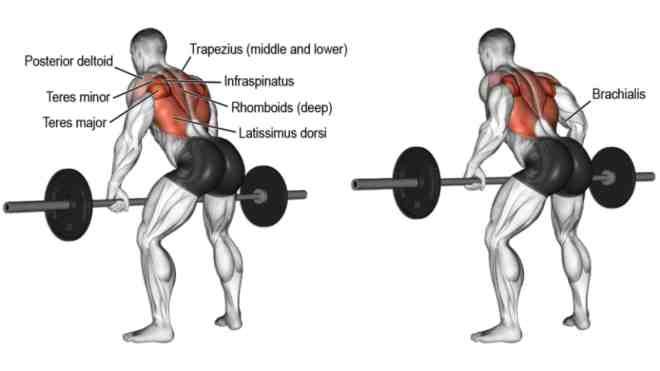
2. Bent Over Barbell Rows
Bent-over barbell rows are a powerhouse exercise for strengthening the upper back and adding significant muscle mass to the region. The angle of your pull determines which muscles are targeted:
Pulling the bar higher toward the chest engages the upper latissimus dorsi and trapezius.
Pulling the bar along a lower trajectory to touch the abdomen targets the lower lats.
This versatility makes bent-over rows an essential addition to any back workout routine.
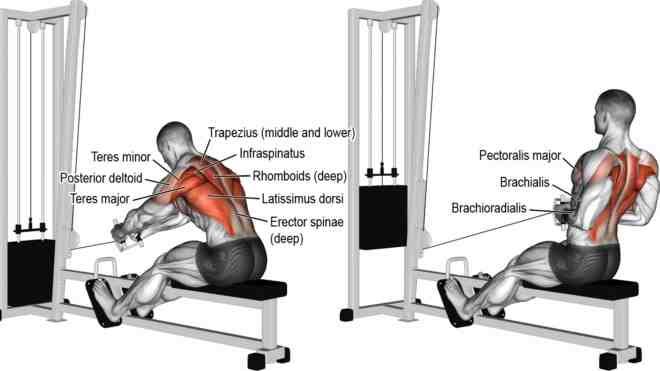
3. Seated Cable Rows
Seated cable rows are excellent for building middle back muscles and engaging the lower lats.
This exercise can be performed using a wide or narrow grip, allowing for versatility in muscle targeting.
It requires a cable rowing machine equipped with separate handles. By maintaining proper form, seated cable rows effectively isolate the back muscles, making them a staple for developing a strong, well-defined back.
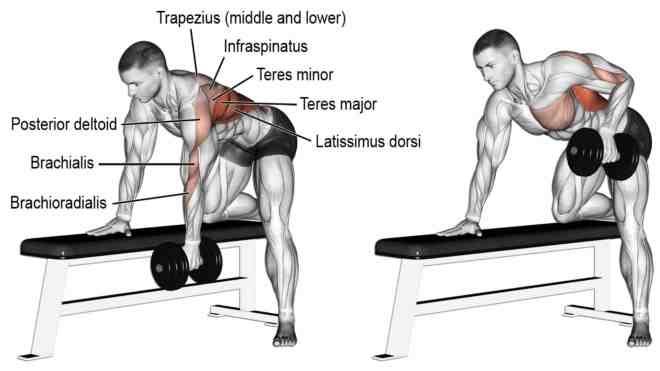
One-arm dumbbell Rows are a highly effective alternative to chest-supported rows, offering the full range of motion needed to build the latissimus dorsi.
This exercise independently targets each side of the back, providing better muscle isolation and a longer range of motion. One-arm dumbbell rows help build a bigger and stronger back and improve posture.
Their simplicity and effectiveness make them a valuable addition to any workout regimen.
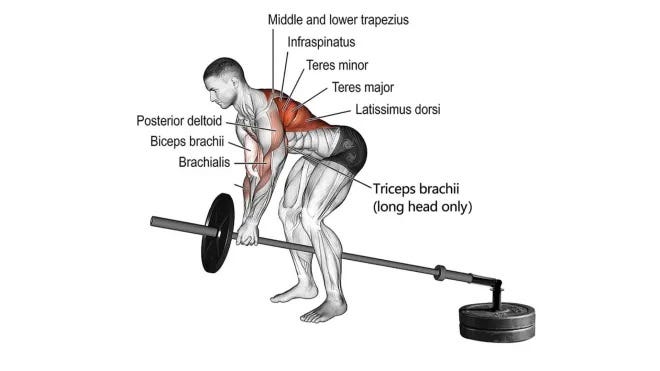
5. T Bar Rows
T bar rows are a power exercise to build middle back muscles. Check the correct execution technique and blast your back muscles. It also works on the outer lats when done with a narrower grip.
T-bar rows are done on a machine or by placing a barbell in the corner. They are tough exercises, but building a strong back is a must to develop a quality physique, stay injury-free, and remain pain-free for life.
The rear delts are crucial for stable and healthy shoulders. They make your shoulders look bigger and improve your posture and shoulder joint mobility.
However, they are often overlooked in workout routines. Underperforming rear delts prevent you from gaining strength with overhead and bench pressing.
Some of the most popular rear delt exercises use equipment such as dumbbells, barbells, machines, or a cable pulley. However, there are also effective bodyweight alternatives you can do at home.
You must choose the right rear delt exercisesand do them in a way that works the posterior delts the most.
In this blog, we will discuss the following points to train the rear deltoid muscles effectively.
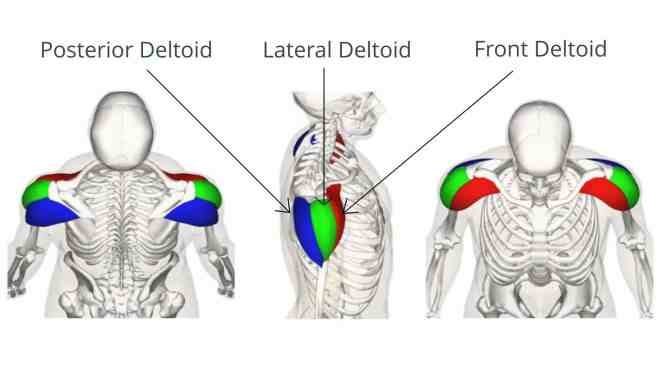
It is commonly called the front delt. It originates from your collar bone and inserts into your humerus (upper arm bone).
The main function of your front delt is to move your arm up, forward, and to your center
Lateral Deltoid
It has a few common names, such as side delts, middle delts, or even outer delts. It arises from a little area on your shoulder blade called the acromion process and inserts into your humerus.
Your lateral delt’s main function is shoulder abduction, which is bringing it up to the side.
Rear Deltoid
Rear Delt also knows as the Posterior Deltoid. It arises from your scapula (upper part of your shoulder blade) and inserts into your humerus.
Your posterior delts main function is moving the arm outward and backward. It is also responsible for external rotation of the shoulder.
The rear delts are involved in many pulling exercises, and it acts as a stabilizer.
Rear Delt Exercises To Build 3D Shoulder
Here, you’ll find the 10 best rear delt exercises for maximum posterior deltoid growth.
Now, let’s get into the best posterior delt exercises for strength and hypertrophy using various types of fitness equipment and some bodyweight rear delt exercises that you can do at home.
1. Bent Over Dumbbell Lateral Raise
The bent-over dumbbell lateral raise, also called the rear delt fly, is a great exercise for building a complete set of shoulders. It is an excellent exercise to isolate and work specifically on rear deltoid muscles.
This exercise can be performed in both a standing and a seated position. I prefer the seated version, as it requires strict movement.
How To Do Bent Over DB Lateral Raise
Sit at the end of a bench with a pair of dumbbells.
Bend forward and let the dumbbells hang on your sides.
Lift the dumbbells on your sides and raise them a little higher than your shoulders.
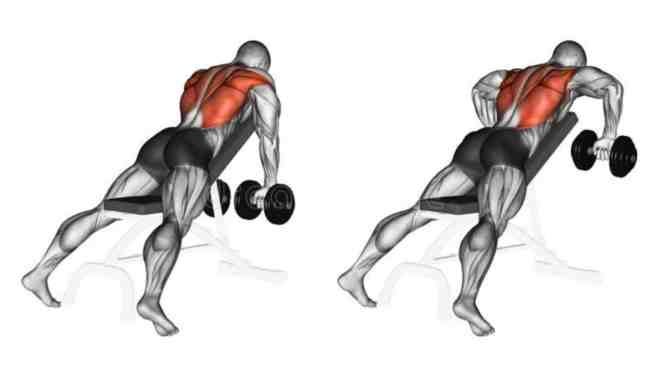
Start off lying on an incline bench with a dumbbell in each hand extended out in front of you.
Slowly pull the dumbbells up until your elbows are just above your shoulders.
Once you reach the final position, hold for a count and squeeze your muscles.
Return to the starting position and repeat for as many reps and sets as desired.
Tips
Keep a controlled motion and avoid jerky movements.
Pause for a moment at the top before slowly lowering the dumbbell back to the starting position.
3. Bent over Cable Lateral Raise
The bent-over cable lateral raise is an exercise that targets the rear deltoid muscles and the upper back and trapezius muscles.
It is performed by standing facing a cable machine with a D-handle attachment at hip height.
Unlike dumbbell raises where the resistance varies during the lift, the cable pulley affords a uniform resistance throughout the motion.
How To Do Bent over Cable Lateral Raise
Grab the handles attached to two low pulleys (left-side handle in right hand, right-side handle in left hand).
Stand in the middle, then bend forward at the waist with back straight and parallel to the floor.
Raise your hands upward in an arc to shoulder level, such that the cables cross over.
Lower the handles back down to the start position, your right hand directly in front of the left ankle and your left hand in front of the right ankle.
Tips
Pull slowly so that you are in control of the weight at all times.
Remember to exhale while you exert.
4. Cable High Row
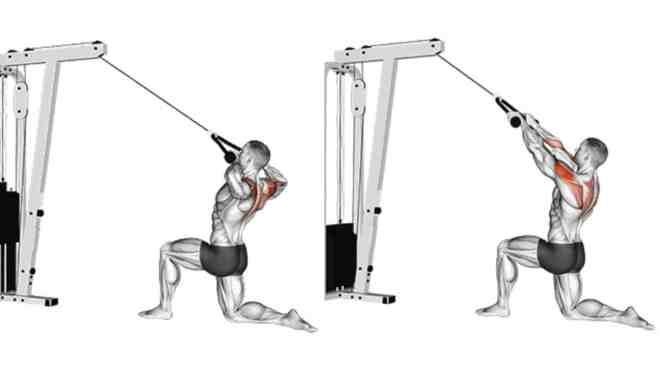
Half kneeling high cable row rope is a tremendous exercise that effectively works many muscles, including the shoulder, back, wing and trapezius muscles.
This exercise gives people with shoulder issues an exercise to get the benefits of rows.
In addition, face pull is one of the most effective corrective exercises for compensating for poor posture and shoulder dysfunction.
How To Do Cable High Row
Set the cable up at a high point with the rope attachments
Grab the rope with both hands using an overhand grip.
Then take a step back and get onto knees facing the cable machine
Starting with your arms stretched out and away, pull back through your elbows until your hands are just in front of your shoulders
Slowly return to the starting position. Repeat for desired reps.
Tips
Don’t lean backwards to pull the weight towards you.
Focus on the mind-muscle connection to pull down by using your rear deltoid muscles.
5. Reverse Cable Crossover
Your arms should move directly back (and downward slightly) almost parallel to the floor to target the rear deltoid.
Ifthe hands are raised through a higher arc to a point above shoulder level, the trapezius, and lateral deltoid make a bigger contribution to the movement.
Crossing your hands over one another (uncrossing the cables) at the start position increases the range of motion.
How To Do Reverse Cable Crossover
Stand in the center of a cable crossover apparatus.
Start with hands crossed in front of you at shoulder height, with the left high cable in your right hand and the right in your left hand.
Pull your elbows out and back as far as possible using your rear delts, then slowly return to the starting position.
Tips
The posterior deltoid is best targeted with your torso upright, not leaning too far forward or back.
Keep a controlled motion and avoid jerky movements.
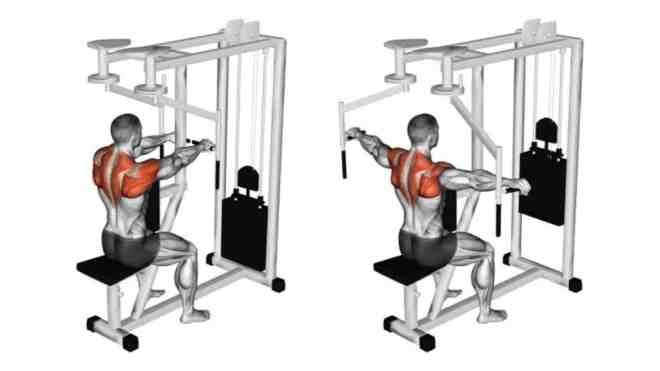
6. Machine Rear Deltoid Fly
Machine rear deltoid fly machine provides a uniform resistance and controlled movement throughout the range of motion.
Additionally, the machine allows for an isolated workout, targeting the rear deltoids specifically.
How To Do Machine Rear Deltoid Fly
Sit facing the rear deltoid machine with your chest against the backrest.
Grasp the handles directly in front of arms outstretched at shoulder level.
Pull the handles back in an arc as far as possible. keep your elbows high and arms parallel to the floor.
Return the handles to the start position directly in front.
Tips
Try not to move anything but your shoulders.
Remember to exhale while you exert.
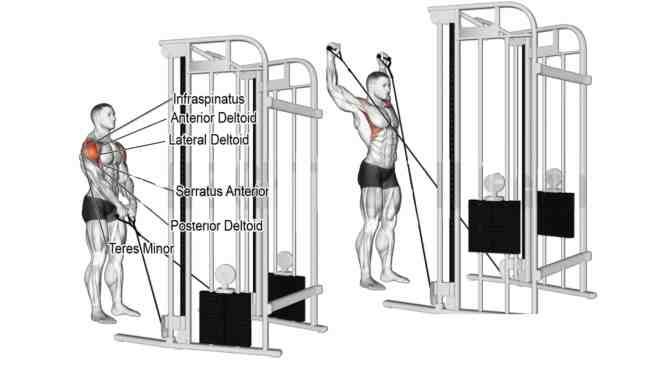
7. Cable Machine Y Raise
The cable Y-raise is a fantastic exercise for the whole shoulder (deltoid) that activates all fibers of the deltoid: anterior, lateral, and posterior.
This exercise strengthens the external shoulder rotators and the internal shoulder rotators.
How To Do Cable Machine Y Raise
Stand facing between two low cable pulleys, with each hand holding the handle of the cable of the opposite pulley.
To maintain good posture, push your chest forward, and point your shoulders back while slightly bending both knees.
Stand straight up with your arm fully extended and feet facing forward.
Maintaining a slight bend in the elbows, raise your arms upwards and outwards, forming the letter ‘Y’ with your whole body.
Hold for a second, and then slowly lower the weight back to the starting position.
Tips
Maintain a fixed, slightly bent elbow position throughout the exercise.
Keep your torso still, your back straight, and your elbow slightly bent.
Don’t just swing your arms. Keep controlled motion throughout the exercise
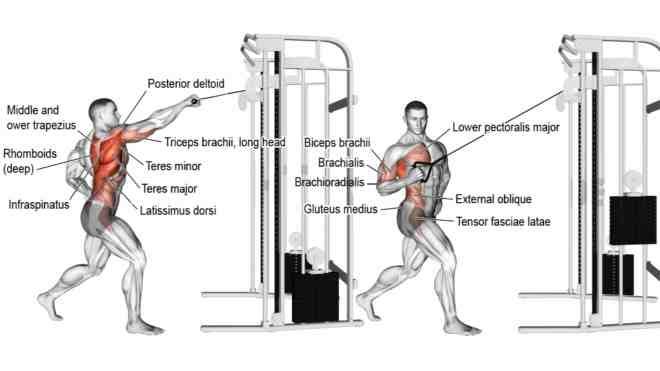
8. Cable Twisting Standing Row
The Cable twisting standing row exercise involves numerous muscles as it requires you to rotate at the waist slightly.
This is a unilateral exercise, which requires you to engage your core throughout the movement.
Attach a single grip handle to an elbow-high cable pulley.
Step back and get into a staggered stance, knees slightly bent.
Your arm should be out straight and your waist is rotated towards the cable.
Pull back towards your waist while rotating your waist to the same direction
Pause briefly at the movement's top, then slowly return to the starting position.
Repeat desired reps.
Tips
Make sure the rotation is in your waist, not hips.
You can place your inactive hand on your other hip for added stability.
Your reps should be slow and controlled to make the most of this move.
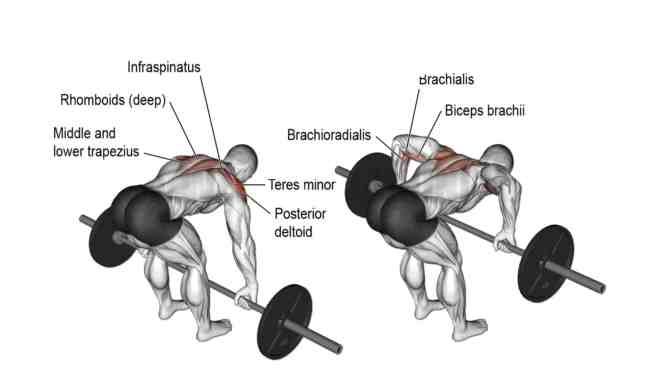
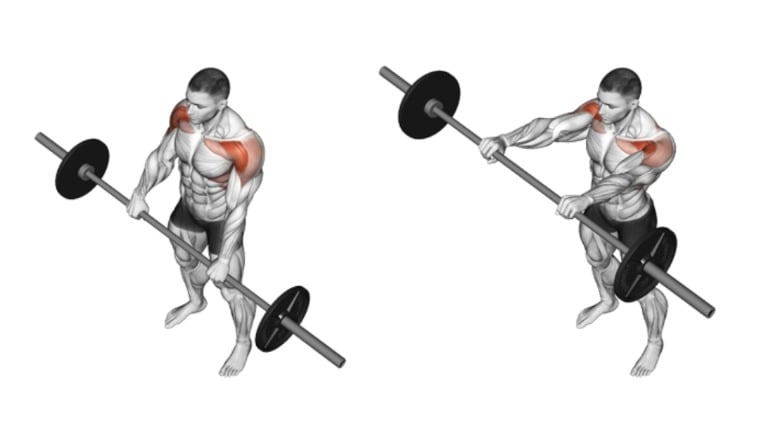
9. Standing Barbell Rear Delt Row
Standing barbell rear delt row is a free weight exercise that primarily targets the rear deltoid and middle back, and to a lesser degree, it also targets the biceps, shoulders, and traps.
If you haven’t done this exercise before, use a light weight on the barbell. Make sure it’s not too heavy or too light.
How To Do Barbell Rear Delt Row
Stand up straight while holding a barbell using a wide (higher than shoulder width) and overhand (palms facing your body) grip.
With slightly bent knees, bend over at the waist so that your chest is parallel with the floor.
While keeping the upper arms perpendicular to the torso, pull the barbell up towards your upper chest as you squeeze the rear delt.
Slowly go back to the initial position as you breathe in.
Repeat for the recommended number of repetitions.
Tips
Refrain from using your biceps to do the work.
Focus on targeting the rear delts, the arms should only act as hooks.
Maintaining the right posture while working out is extremely important.
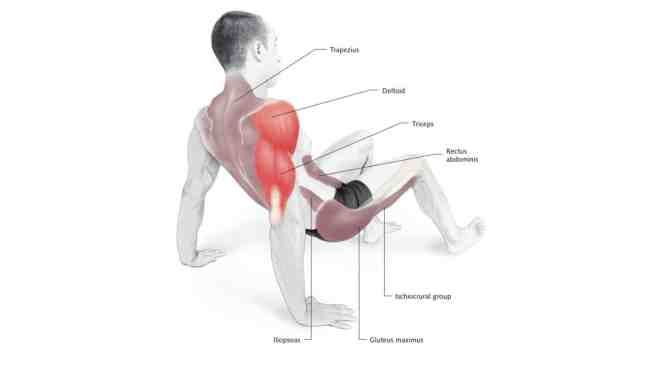
10. Crab Walk
The crab walk is a great total-body exercise that requires no extra equipment, so it’s a good move when you don’t have much time or fitness equipment.
It mainly works the upper arms, rear and front shoulders, upper legs, and core.
How To Do Crab Walk
Position your hands and feet so that they are flat on the ground, and you are faces up.
Lift your butt up off the ground by tightening your gluteal muscles.
Begin “walking” by first moving your hands and then your feet.
To avoid excessive shoulder strain, move your hands no more than 6 to 8 inches (15 to 20 cm) at a time.
Tips
As a caution, do not let your feet get moving too fast for your upper body so as not to injure your shoulders.
Control your movements and focus on the rear delt muscle contraction.
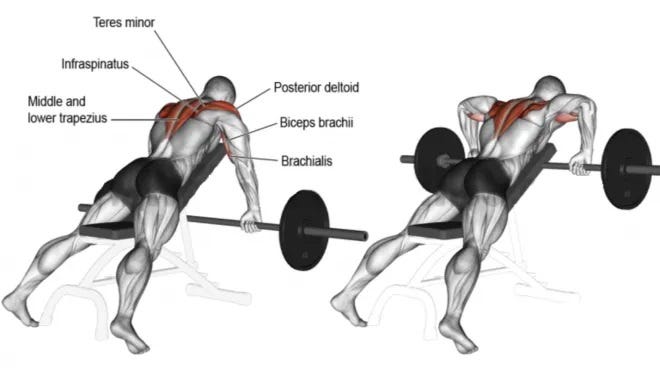
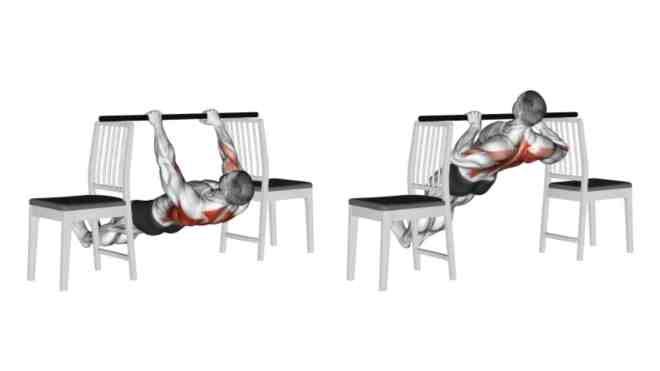
4. Inverted Row
An inverted row puts your body in a horizontal position, making it easier to lift weights.
It works the back and shoulder muscles from a different angle and improves scapular retraction.
But, you can also perform the inverted row at home by lying under a chair, holding the chair’s sides, and pulling yourself up.
How To Do Inverted Row
Adjust the height of the chair and bar so that it’s a little higher than arm’s length from the floor.
Lie under the bar with your legs and body straight.
Grasp the bar with an overhand grip that’s a little wider than shoulder width.
Keeping your legs and body straight, exhale as you pull your chest up to the bar.
Hold for a count of two and squeeze your rear delt muscles.
Inhale as you lower your body until your arms and shoulders are fully extended. Repeat.
Rear Delt Workout Routine
This rear delt workout routine targets the posterior deltoid head with various effective exercises.
Perform this routine 2–3 times weekly to enhance your rear delts and elevate your shoulder training.
Barbell Shoulder Press: Sets: 3–4 & Reps: 10–12
Bent-Over Dumbbell Rear Delt FLy: Sets: 3–4 & Reps: 12–15
Large rear delts help round out the shoulders to create the boulder-shoulder look that many of you are training, all while improving health and performance.
Big, strong, rounded shoulders have numerous benefits besides just looking good. The deltoids are among the most important muscles in the body, as we use them in everyday life to push, pull, and lift objects over our heads.
You may be surprised to know that your anterior deltoids are the biggest of the three deltoid heads.
Your front delts are activated during all compound pressing exercises, such as push-ups, bench presses, and overhead presses.
But sometimes, we must focus more on the front delt to build a bigger, round shoulder. Building strong anterior deltoids helpsimprove postureand make arm movements that involve shoulder abduction more powerful and productive.
In this post, we will discuss the following give you techniques on How to grow your front delts, best exercises, execution techniques, pro tips
7 Best Exercises To Build Bigger Front Delts
While numerous exercises target the anterior deltoid exist, there are two types of exercises: presses and raises.
Presses, like incline bench presses and overhead presses, are the ultimate anterior deltoid strength exercises. It is a compound exercise that targets many other muscle fibers.
Raises, such as shoulder front raises and many other variations, are isolation exercises that mainly target the front deltoid. Front delts respond well to light weights with high volume, particularly regarding hypertrophy.
And There are MANY ways to train the front deltoid using different gym types of equipment:
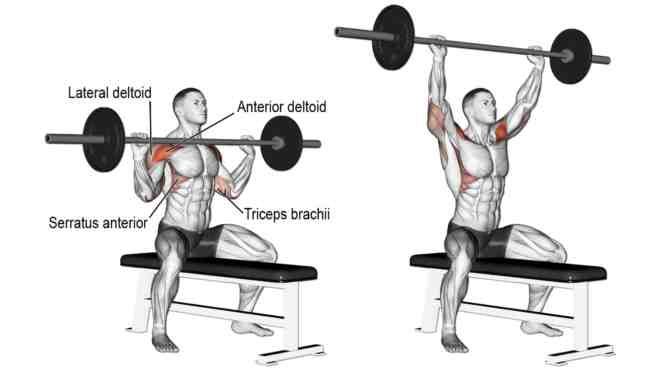
The seated shoulder press is the favorite shoulder exercise among bodybuilders because it builds muscle fast and is a power move.
Performing the exercise while seated upright is a stricter version than standing and prevents cheating the weight upward using momentum generated by the legs.
How To Do
Sit on an exercise bench and grab a bar with an overhand grip.
Bring the bar over and in front of your head, under your chin, and just above your upper chest.
Now Press the bar straight up overhead until your arms are fully extended but not locked out.
Slowly lower the bar back to the starting position.
Tips
Perform a warm-up with 50% weight for 1–2 sets.
Always perform the Shoulder Exercises before you perform the triceps.
2. Barbell front raise
The barbell front raise is an effective exercise for targeting the anterior deltoids as you can perform it in various grip widths and hand positions.
The barbell allows you to overload the muscles more than you could with dumbbells.
How To Do
Stand with your feet shoulder-width apart and grasp a barbell with an overhand grip.
Hold the barbell in front of your thighs, palms facing down, and your hands slightly wider than shoulder-width apart.
Keep your back straight, engage your core, and slightly bend your elbows.
Lift the barbell up slowly in front of you. Make sure your arms are parallel to the ground or slightly higher.
Pause briefly at the top of the movement, then lower the barbell back down to the starting position.
Tips
Maintain a neutral back and engage your core.
Keep a controlled motion and avoid jerky movements.
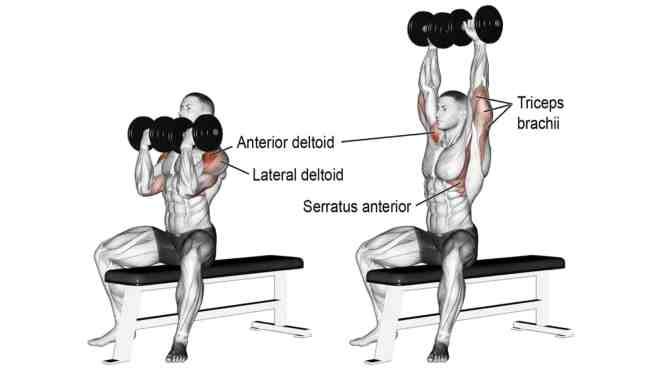
The Arnold shoulder press is a popular exercise named after the legendary bodybuilder Arnold Schwarzenegger.
It stands out from the crowd as the best exercise with the best range of motion for shoulder muscles.
It provides a wide range of motion as you lower the dumbbells well down in front, achieving the maximum stretch other shoulder exercises lack.
How To Do
Sit on a bench or standing tall with feet shoulder-width apart.
Hold the dumbbells at shoulder level with your palms facing your body.
Begin the movement by pressing the dumbbells overhead while simultaneously rotating your palms away from your body.
As you press upward, rotate your palms until they face forward.
Pause at the top and then reverse the movement by rotating your palms back towards your body as you lower the dumbbells back down to the starting position.
Tips
Keep a controlled motion and avoid jerky movements.
Do not lock your arms overhead.
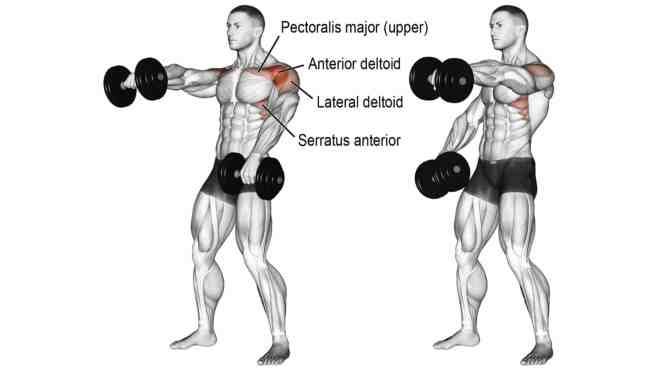
5. Dumbbell Front Raise
The dumbbell front raise is one of the best isolation exercises for isolating the front deltoid muscle.
This exercise can be done with a pair of dumbbells standing or sitting. The seated version requires strict form and prevents cheating.
It is also possible to perform them alternatingly or with both hands together.
How To Do
Stand holding a pair of dumbbells across the front of your thighs.
Your feet are shoulder-width apart, and your knees are slightly bent.
Raise one dumbbell (say right hand) in front of you until it reaches just above shoulder level.
Now lower the weight (of the right hand) while raising the left in front of you.
Perform this exercise in this alternating manner.
Tips
Pause momentarily at the top, then slowly lower the dumbbell back to the starting position.
Concentrate on training the front delts. Lift dumbbells before you; do not raise them outside the body.
6. Cable front raise
The cable front raise is useful because it provides constant tension on the front delt as you move the weight through the range of motion.
You can also perform the cable front raise using a rope attachment or a single stirrup, one arm at a time.
How To Do
Attach a straight bar to a low cable pulley.
Grab the bar using a shoulder-width or wider overhand grip.
Stand close to the pulley with your body upright, your shoulders pulled back.
Exhale as you pull the bar up the front of your body until the bar is at shoulder height.
Hold for a count of two. Inhale as you lower the bar to the starting position.
Tips
Keep your shoulders back, chest out, and body upright.
Pause for a moment at the top position.
Try not to bounce at the top of the movement, allow the shoulders to flex and then lower slowly.
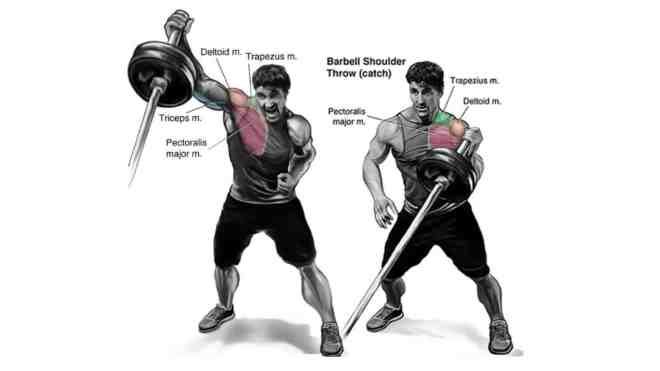
7. Barbell Push Press
The barbell push press is a works multiple muscle groups, including shoulders, triceps, core, and legs.
It allows you to lift heavier weights overhead compared to a strict military press.
How To Do
Place your feet hip-width apart and grasp a barbell at shoulder height with an overhand grip.
Bend your knees and dip your hip back.
Bend your knees slightly as if performing a shallow squat. This is the “dip” phase.
Now, explosively extend your legs to drive upwards, generating momentum.
As your legs extend, simultaneously press the barbell directly overhead until your arms are straight
Slowly lower the barbell back to the starting position at your shoulders.
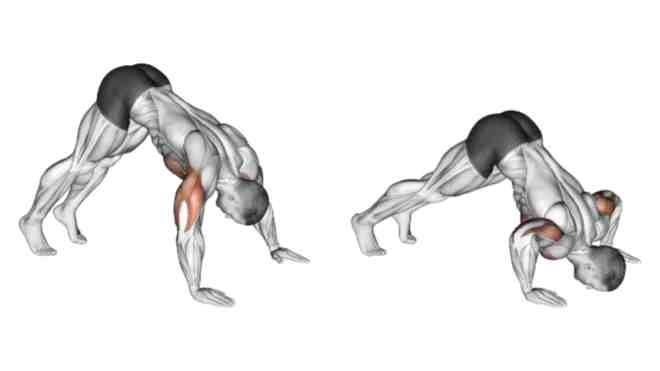
The pike push-up looks like a mash-up of Downward-Facing Dog and Dolphin Pose, and this move can build major strength.
Perform this exercise more upright to target the shoulders more than the chest.
How To Do
Start in a standard push-up position with your hands slightly wider than shoulder-width apart and elbows completely locked out.
Lift the hips up and back until your body forms an inverted V shape.
Keep arms and legs as straight as possible.
Slowly lower the top of your head towards the ground.
Once your head is about to contact the ground, pause for a second.
Then slowly push back until your arms are straight, and you’re in the inverted V position.
Tips
Make sure you maintain control throughout the movement.
Optimal Sets and Reps
Here’s a breakdown of optimal sets and reps for different training styles:
Strength Training
Sets: 3
Reps: 6–10
Hypertrophy
Sets: 3
Reps: 8–15
Endurance Training
Sets: 3
Reps: 12–30
Power Training
Sets: 3
Reps: 5–8 (Explosive)
Conclusion
These anterior deltoid exercises are recommended for anyone who wants to build a bigger shoulder and gain strength.
It allows for targeted muscle development and provides an overall 3D look to the shoulder. It is easy to do and requires no more scientific details or fancy equipment. You should incorporate some of these 7 exercises into your workout regimen.
To sum it up, you should hit your front delts directly at least 1 time a week, but if you’re lacking in this area, you might want to work them more often than that.