The rear delts are crucial for stable and healthy shoulders. They make your shoulders look bigger and improve your posture and shoulder joint mobility.
However, they are often overlooked in workout routines. Underperforming rear delts prevent you from gaining strength with overhead and bench pressing.
Some of the most popular rear delt exercises use equipment such as dumbbells, barbells, machines, or a cable pulley. However, there are also effective bodyweight alternatives you can do at home.
You must choose the right rear delt exercises and do them in a way that works the posterior delts the most.
In this blog, we will discuss the following points to train the rear deltoid muscles effectively.
- Delt Anatomy and Functions
- How To Train Rear Delt
- Best Rear Delt Exercises
- Technique and Pro-tips.
- Benefits of Strong Rear Deltoids
- Workout Routine (Plan)
Try Our FREE Workout Planner to generate your customized workout plans

Anatomy & Function of the Rear Deltoid
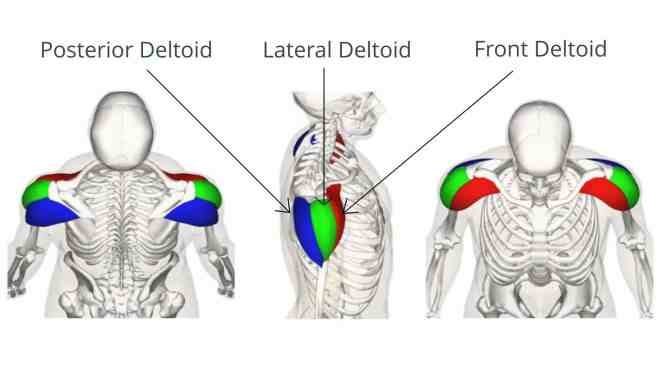
The deltoid muscle of the shoulder consists of three separate sections or heads.
- The anterior deltoid (In front)
- Lateral deltoid (at the side)
- Rear deltoid (posterior or behind)
Anterior Deltoid
It is commonly called the front delt. It originates from your collar bone and inserts into your humerus (upper arm bone).
The main function of your front delt is to move your arm up, forward, and to your center
Lateral Deltoid
It has a few common names, such as side delts, middle delts, or even outer delts. It arises from a little area on your shoulder blade called the acromion process and inserts into your humerus.
Your lateral delt’s main function is shoulder abduction, which is bringing it up to the side.
Rear Deltoid
Rear Delt also knows as the Posterior Deltoid. It arises from your scapula (upper part of your shoulder blade) and inserts into your humerus.
Your posterior delts main function is moving the arm outward and backward. It is also responsible for external rotation of the shoulder.
The rear delts are involved in many pulling exercises, and it acts as a stabilizer.
Rear Delt Exercises To Build 3D Shoulder
Here, you’ll find the 10 best rear delt exercises for maximum posterior deltoid growth.
Now, let’s get into the best posterior delt exercises for strength and hypertrophy using various types of fitness equipment and some bodyweight rear delt exercises that you can do at home.
1. Bent Over Dumbbell Lateral Raise
The bent-over dumbbell lateral raise, also called the rear delt fly, is a great exercise for building a complete set of shoulders. It is an excellent exercise to isolate and work specifically on rear deltoid muscles.
This exercise can be performed in both a standing and a seated position. I prefer the seated version, as it requires strict movement.

How To Do Bent Over DB Lateral Raise
- Sit at the end of a bench with a pair of dumbbells.
- Bend forward and let the dumbbells hang on your sides.
- Lift the dumbbells on your sides and raise them a little higher than your shoulders.
- Now lower the dumbbells back to your sides.
Tips
- Your arms should be parallel to your shoulders.
- Keep strict form to isolate the rear delts.
Try Our FREE Workout Planner to generate your customized workout plans..
2. Lying Dumbbell Rear Delt Row
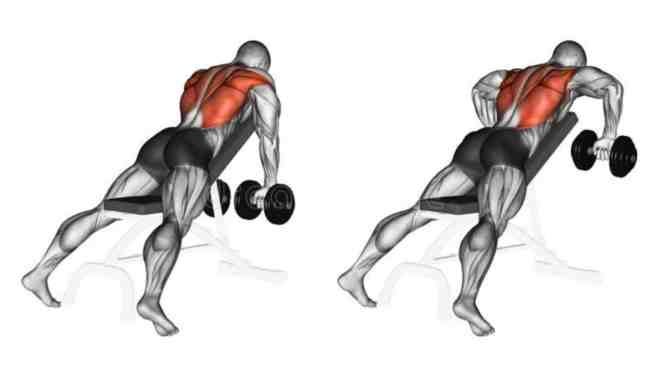
The lying dumbbell rear delt row is an exercise that targets the rear deltoid muscles, as well as the upper back and trapezius muscles.
Stabilizing your torso on the bench will help prevent cheating or swinging of the weights.
It may be a good option for those who are looking to vary their routine or reduce strain on their lower back.
How To Do Lying Dumbbell Rear Delt Row
- Start off lying on an incline bench with a dumbbell in each hand extended out in front of you.
- Slowly pull the dumbbells up until your elbows are just above your shoulders.
- Once you reach the final position, hold for a count and squeeze your muscles.
- Return to the starting position and repeat for as many reps and sets as desired.
Tips
- Keep a controlled motion and avoid jerky movements.
- Pause for a moment at the top before slowly lowering the dumbbell back to the starting position.
3. Bent over Cable Lateral Raise
The bent-over cable lateral raise is an exercise that targets the rear deltoid muscles and the upper back and trapezius muscles.
It is performed by standing facing a cable machine with a D-handle attachment at hip height.
Unlike dumbbell raises where the resistance varies during the lift, the cable pulley affords a uniform resistance throughout the motion.

How To Do Bent over Cable Lateral Raise
- Grab the handles attached to two low pulleys (left-side handle in right hand, right-side handle in left hand).
- Stand in the middle, then bend forward at the waist with back straight and parallel to the floor.
- Raise your hands upward in an arc to shoulder level, such that the cables cross over.
- Lower the handles back down to the start position, your right hand directly in front of the left ankle and your left hand in front of the right ankle.
Tips
- Pull slowly so that you are in control of the weight at all times.
- Remember to exhale while you exert.
4. Cable High Row
Half kneeling high cable row rope is a tremendous exercise that effectively works many muscles, including the shoulder, back, wing and trapezius muscles.
This exercise gives people with shoulder issues an exercise to get the benefits of rows.
In addition, face pull is one of the most effective corrective exercises for compensating for poor posture and shoulder dysfunction.
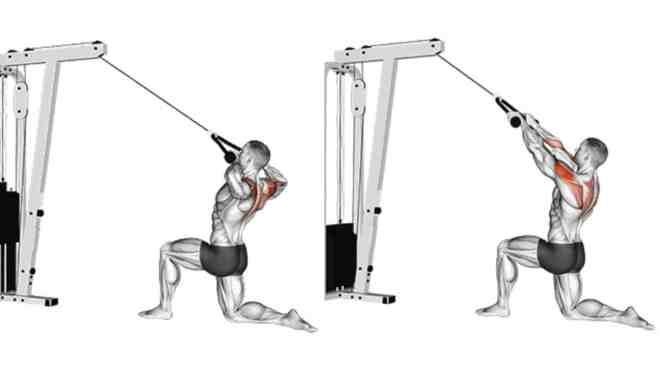
How To Do Cable High Row
- Set the cable up at a high point with the rope attachments
- Grab the rope with both hands using an overhand grip.
- Then take a step back and get onto knees facing the cable machine
- Starting with your arms stretched out and away, pull back through your elbows until your hands are just in front of your shoulders
- Slowly return to the starting position. Repeat for desired reps.
Tips
- Don’t lean backwards to pull the weight towards you.
- Focus on the mind-muscle connection to pull down by using your rear deltoid muscles.
5. Reverse Cable Crossover
Your arms should move directly back (and downward slightly) almost parallel to the floor to target the rear deltoid.
If the hands are raised through a higher arc to a point above shoulder level, the trapezius, and lateral deltoid make a bigger contribution to the movement.
Crossing your hands over one another (uncrossing the cables) at the start position increases the range of motion.
How To Do Reverse Cable Crossover
- Stand in the center of a cable crossover apparatus.
- Start with hands crossed in front of you at shoulder height, with the left high cable in your right hand and the right in your left hand.
- Pull your elbows out and back as far as possible using your rear delts, then slowly return to the starting position.
Tips
- The posterior deltoid is best targeted with your torso upright, not leaning too far forward or back.
- Keep a controlled motion and avoid jerky movements.
6. Machine Rear Deltoid Fly
Machine rear deltoid fly machine provides a uniform resistance and controlled movement throughout the range of motion.
Additionally, the machine allows for an isolated workout, targeting the rear deltoids specifically.
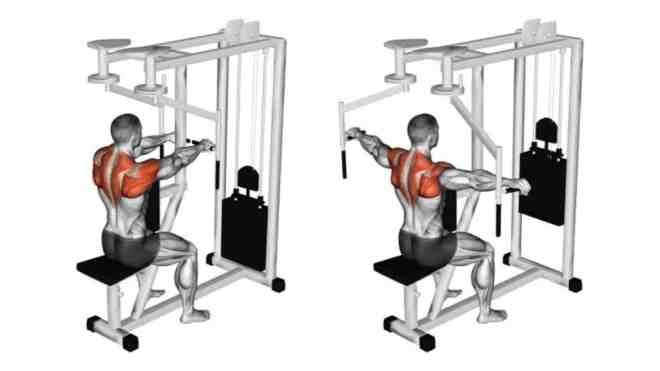
How To Do Machine Rear Deltoid Fly
- Sit facing the rear deltoid machine with your chest against the backrest.
- Grasp the handles directly in front of arms outstretched at shoulder level.
- Pull the handles back in an arc as far as possible. keep your elbows high and arms parallel to the floor.
- Return the handles to the start position directly in front.
Tips
- Try not to move anything but your shoulders.
- Remember to exhale while you exert.
7. Cable Machine Y Raise
The cable Y-raise is a fantastic exercise for the whole shoulder (deltoid) that activates all fibers of the deltoid: anterior, lateral, and posterior.
This exercise strengthens the external shoulder rotators and the internal shoulder rotators.
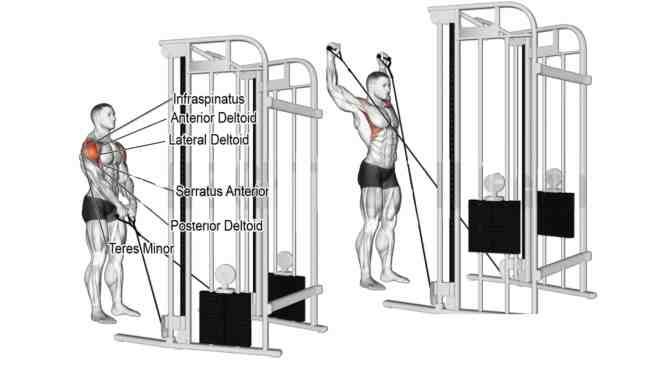
How To Do Cable Machine Y Raise
- Stand facing between two low cable pulleys, with each hand holding the handle of the cable of the opposite pulley.
- To maintain good posture, push your chest forward, and point your shoulders back while slightly bending both knees.
- Stand straight up with your arm fully extended and feet facing forward.
- Maintaining a slight bend in the elbows, raise your arms upwards and outwards, forming the letter ‘Y’ with your whole body.
- Hold for a second, and then slowly lower the weight back to the starting position.
Tips
- Maintain a fixed, slightly bent elbow position throughout the exercise.
- Keep your torso still, your back straight, and your elbow slightly bent.
- Don’t just swing your arms. Keep controlled motion throughout the exercise
8. Cable Twisting Standing Row
The Cable twisting standing row exercise involves numerous muscles as it requires you to rotate at the waist slightly.
This is a unilateral exercise, which requires you to engage your core throughout the movement.
Besides being a great back and shoulder exercise, this movement also works your hips, glutes and other lower body muscles.
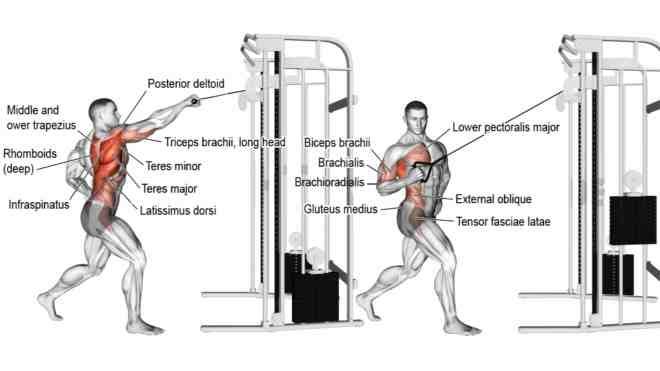
How To Do Cable Twisting Standing Row
- Attach a single grip handle to an elbow-high cable pulley.
- Step back and get into a staggered stance, knees slightly bent.
- Your arm should be out straight and your waist is rotated towards the cable.
- Pull back towards your waist while rotating your waist to the same direction
- Pause briefly at the movement's top, then slowly return to the starting position.
- Repeat desired reps.
Tips
- Make sure the rotation is in your waist, not hips.
- You can place your inactive hand on your other hip for added stability.
- Your reps should be slow and controlled to make the most of this move.
9. Standing Barbell Rear Delt Row
Standing barbell rear delt row is a free weight exercise that primarily targets the rear deltoid and middle back, and to a lesser degree, it also targets the biceps, shoulders, and traps.
If you haven’t done this exercise before, use a light weight on the barbell. Make sure it’s not too heavy or too light.
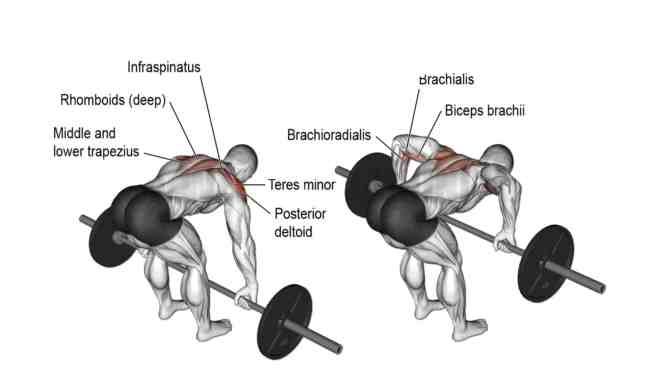
How To Do Barbell Rear Delt Row
- Stand up straight while holding a barbell using a wide (higher than shoulder width) and overhand (palms facing your body) grip.
- With slightly bent knees, bend over at the waist so that your chest is parallel with the floor.
- While keeping the upper arms perpendicular to the torso, pull the barbell up towards your upper chest as you squeeze the rear delt.
- Slowly go back to the initial position as you breathe in.
- Repeat for the recommended number of repetitions.
Tips
- Refrain from using your biceps to do the work.
- Focus on targeting the rear delts, the arms should only act as hooks.
- Maintaining the right posture while working out is extremely important.
10. Crab Walk
The crab walk is a great total-body exercise that requires no extra equipment, so it’s a good move when you don’t have much time or fitness equipment.
It mainly works the upper arms, rear and front shoulders, upper legs, and core.
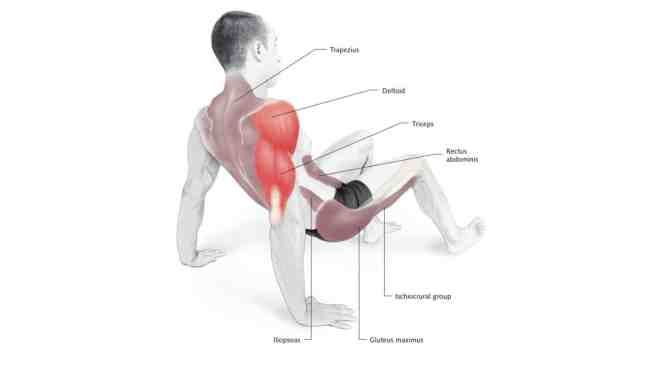
How To Do Crab Walk
- Position your hands and feet so that they are flat on the ground, and you are faces up.
- Lift your butt up off the ground by tightening your gluteal muscles.
- Begin “walking” by first moving your hands and then your feet.
- To avoid excessive shoulder strain, move your hands no more than 6 to 8 inches (15 to 20 cm) at a time.
Tips
- As a caution, do not let your feet get moving too fast for your upper body so as not to injure your shoulders.
- Control your movements and focus on the rear delt muscle contraction.
4. Inverted Row
An inverted row puts your body in a horizontal position, making it easier to lift weights.
It works the back and shoulder muscles from a different angle and improves scapular retraction.
But, you can also perform the inverted row at home by lying under a chair, holding the chair’s sides, and pulling yourself up.
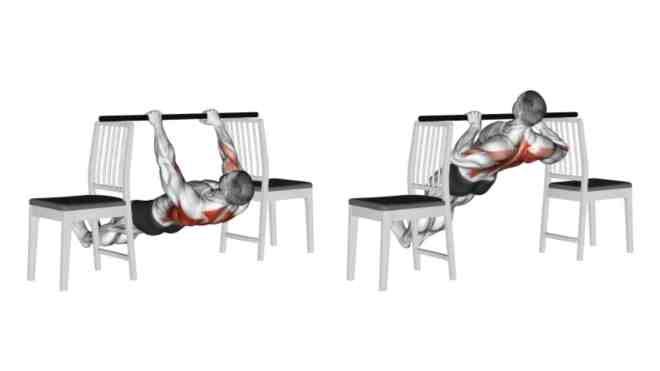
How To Do Inverted Row
- Adjust the height of the chair and bar so that it’s a little higher than arm’s length from the floor.
- Lie under the bar with your legs and body straight.
- Grasp the bar with an overhand grip that’s a little wider than shoulder width.
- Keeping your legs and body straight, exhale as you pull your chest up to the bar.
- Hold for a count of two and squeeze your rear delt muscles.
- Inhale as you lower your body until your arms and shoulders are fully extended. Repeat.
Rear Delt Workout Routine
This rear delt workout routine targets the posterior deltoid head with various effective exercises.
Perform this routine 2–3 times weekly to enhance your rear delts and elevate your shoulder training.
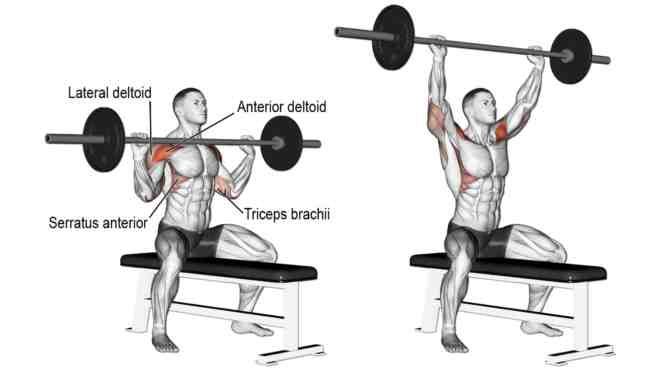
- Barbell Shoulder Press: Sets: 3–4 & Reps: 10–12
- Bent-Over Dumbbell Rear Delt FLy: Sets: 3–4 & Reps: 12–15
- Face Pulls: Sets: 3–4 & Reps: 12–15
- Rear Delt Dumbbell Rows: Sets: 3–4 & Reps: 10–12
Rear Delt Cable Workout Plan
- Cable Reverse Flyes: Sets: 3–4 & Reps: 12–15
- Face Pulls: Sets: 3–4 & Reps: 12–15
- Cable Rear Delt Row: Sets: 3–4 & Reps: 10–12
- Single-Arm Cable Reverse Flyes: Sets: 3–4 & Reps: 10–12
- Cable High Pulls: Sets: 3–4 & Reps: 10–12
Rear Delt Dumbbell-Only Workout Plan
- Bent-Over Dumbbell Reverse Flyes: Sets: 3–4 & Reps: 12–15
- Dumbbell Rear Delt Row: Sets: 3–4 & Reps: 10–12
- Dumbbell Reverse Fly on Incline Bench: Sets: 3–4 & Reps: 12–15
- Side-Lying Rear Delt Fly: Sets: 3–4 & Reps: 10–12
- Head Supported Rear Delt Fly: Sets: 3–4 & Reps: 10–12
Benefits of Strong Rear Deltoids
Regular posterior deltoid exercises have many benefits, including improving posture and strengthening the overall deltoid.
Doing these exercises can also help you avoid the back and shoulder pain of poor posture. Other benefits of it include.
1. Improve Posture
The ‘desk job’ posture, is where most people spend most of the day hunched over their computer with poor posture.
A rounded back and hunched shoulders is a recipe for long-term hunching and injury.
By strengthening the rear delts, your shoulders will tighten your upper back and help straighten your posture.
2. Build a bigger Bench Press
Even though it may seem counterintuitive, strong rear delts will lead to a bigger bench press because the shoulders can handle heavier loads.
3. Reduce the Risk of Shoulder Injury
Working the rear delts will help strengthen your shoulders and add muscle, lowering the risk of rotator cuff injuries.
4. Improved Looks
Large rear delts help round out the shoulders to create the boulder-shoulder look that many of you are training, all while improving health and performance.
Thanks for reading, enjoy Rear delt exercises!
References
- Brown, JM; Wickham, JB; McAndrew, DJ; Huang, XF (2007). “Muscles within muscles: Coordination of 19 muscle segments within three shoulder muscles during isometric motor tasks”. J Electromyogr Kinesiol. 17 (1): 57–73. doi:10.1016/j.jelekin.2005.10.007. PMID 16458022
- Campos YAC, Vianna JM, Guimarães MP, Oliveira JLD, Hernández-Mosqueira C, da Silva SF, Marchetti PH. Different Shoulder Exercises Affect the Activation of Deltoid Portions in Resistance-Trained Individuals. J Hum Kinet. 2020 Oct; 75: 5–14. doi: 10.2478/hukin-2020–0033.